

If you think concrete flooring only belongs in basements, garages, and commercial spaces, you might be surprised that more and more people are using concrete throughout their homes as a contemporary, easy-care alternative to wood, tile, or carpet.
Find concrete flooring contractors near me.
With its low maintenance, durability, and endless customization options, concrete flooring offers the perfect balance of aesthetics and functionality. It can be stained nearly any color, given a variety of textures and finishes, or polished to a sleek, high-gloss shine. Plus, concrete is long-lasting and environmentally friendly, making it one of the most sustainable flooring options available. But before you consider installing a decorative concrete floor in your own home, you should learn more about the pros and cons to determine if it’s right for your lifestyle, design tastes, and budget.

Pros of Concrete Floors
Can be used in any room:
There really is no room in the home where you can’t use decorative concrete. Because of its ability to withstand heavy foot traffic, food and drink spills, and moisture, concrete is an ideal tough-as-nails material for foyers, hallways, bathrooms, and kitchen floors. Plus the adaptability of concrete to any design style — from traditional to ultra-modern — makes it well-suited as a key architectural element in living rooms, great rooms, and finished basements (check out ideas for basement floors).
Get design ideas for using concrete floors in various rooms of the home.
Affordable when compared to other options:
One of the major benefits of decorative concrete flooring is its affordability, particularly if you already have a concrete subfloor that’s ready for staining, polishing or application of a coating or concrete overlay. The cost per square foot for a basic design is comparable to linoleum, vinyl, carpet or lower-priced ceramic tile. And when compared with high-end floor coverings, such as slate and marble, decorative concrete is often an economical alternative.
See the average concrete flooring costs and the factors that will influence how much you’ll pay.
Sustainability:
Many homeowners choose decorative concrete floors because they can be customized in pattern, color, and finish to achieve any look imaginable, freeing them from the constraints of premanufactured flooring materials. No other flooring gives you this unlimited array of design options and opportunities to create custom one-of-a-kind looks. Check out these popular finish options for indoor concrete flooring.
Color options abound:
Stains, dyes, paints, and coatings make it possible to turn a plain-gray concrete floor into nearly any hue imaginable, from basic brown to vibrant multi-colored designs. But if a minimalist look is more your style, concrete floors left their natural color are perfect for giving indoor spaces a modern, industrial vibe. Learn more about the most popular coloring options and techniques for concrete floors.
Easy to clean:
In addition to being nearly indestructible, concrete floors are also super-easy to clean, especially when compared to carpet and grouted tile floors. When properly sealed, concrete floors only need occasional dry or damp mopping to keep them looking like new. Learn more about the cleaning and maintenance of concrete floors.
Pet friendly:
Few flooring materials are friendlier to pets and their owners than concrete. Not only do concrete floors resist pet stains and odors, they won't harbor fleas or mites that your pets may carry into the home. Concrete floors are also nontoxic and won’t emit volatile organic compounds that can be harmful to you as well as your pets. See Six Reasons Why Concrete Floors are Pet Friendly.
Good light reflectivity:
Concrete floors that have been polished or finished with a high-gloss sealer can save energy and reduce lighting bills by amplifying the amount of natural light entering a home during the day and reducing the need for artificial lighting at night. The glossier the finish, the more reflection from lighting you’ll get and the greater the reduction in energy costs. See Reflective Concrete Floors.
Improves the flow from indoor to outdoor rooms:
More homeowners are blurring the boundaries between the indoors and outdoors by making the transition between the two areas virtually seamless. Concrete is one of the few materials that can be used for slabs both indoors and out, and the color palette and design can be inspired by elements found in the surrounding landscape.
CONS OF CONCRETE FLOORS
Usually intended for existing slabs:
In most cases, decorative concrete floors are only practical if there’s an existing concrete slab-on-grade or basement floor to work with. However, it is possible is to install concrete right over an existing floor covering, such as sheet vinyl, tile or wood, by using a decorative overlay or microtopping. See Making the Switch to Concrete Floors.
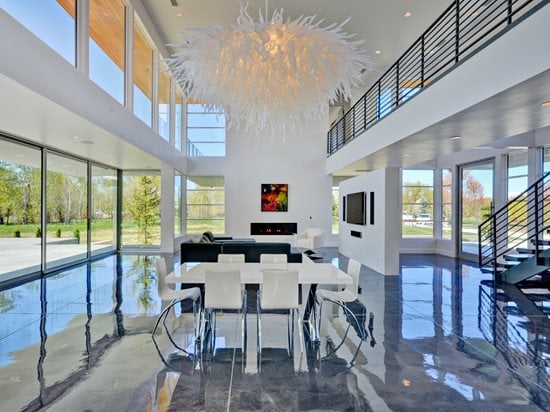
Westcoat in San Diego, CA
Can take several days to install:
Unlike carpeting, a decorative concrete floor can’t be installed in just a few hours or a day. Depending on the condition of the concrete and the decorative technique desired, you can expect the work to take several days or longer. More complex projects involving multiple stain or dye colors, decorative sawcuts, and custom graphics will take much longer to complete than a simple job calling for just a coat of stain and a sealer. See How to Install Concrete Floors.
Requires occasional resealing:
Protecting concrete floors with a good sealer will make them nearly impervious to stains and abrasion, helping to preserve the decorative finish. However in areas of heavy traffic, such as entrances and foyers, you may need to reapply the sealer every few years to provide continual protection and make your floors easier to maintain. Learn more: Sealing Concrete Floors.
May be cold in winter:
Concrete floors can feel cold underfoot during the winter months, but no more so than ceramic tile or natural stone flooring. An easy solution is to use area rugs to buffer the chill. But it’s also possible to warm up decorative concrete floors by adding radiant in-floor heating, which can also be used as an energy-saving alternative to a forced-air heating system.
Can develop cracks over time:
The most common objection to concrete floors is the potential for cracking due to settlement or shrinkage. However, not all cracks in concrete are serious enough to require repair. As long as they're not creating structural problems, the cracks in a floor can be an asset to the design, adding to the character and rustic nature of the concrete (see Incorporating Cracks in Concrete Floor Design). If the cracks are perceived as an eyesore, the floor can be covered with a decorative concrete overlay to create a new, flawless surface.
0 comments